

Treating teeth grinding in Zurich: bite splint or injection treatment?
In short: A custom-made bite splint is the basic treatment for teeth grinding and clenching (bruxism): it protects the teeth and relieves the jaw joints and chewing muscles. If tension, jaw pain or headaches persist despite the splint, the overactive chewing muscles can additionally be treated with targeted injections of a muscle-relaxing agent. Dr. Michael Adler provides both treatments at the Swiss Dental Center at Hardbrücke in Zurich – after an examination that shows which combination makes sense for you.
Book an appointment · More about grinding and bruxism · Costs & health insurance
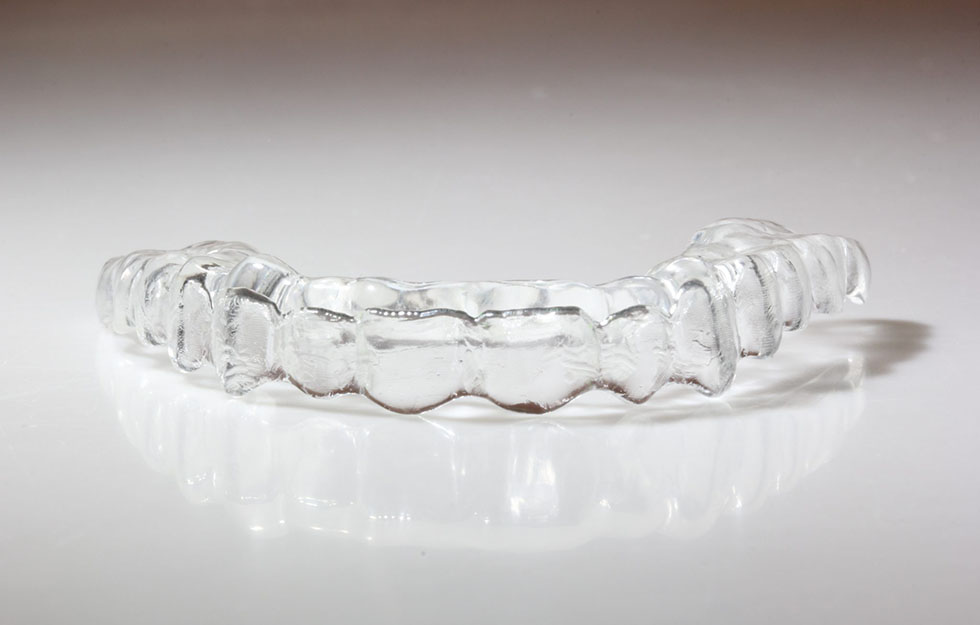
The two treatments at a glance
Bite splint: protection for teeth and jaw joints
A bite splint is worn at night and, if needed, during the day. It distributes the chewing forces evenly, protects the tooth substance from further wear and brings the jaw joints and chewing muscles into a more relaxed position. At the Swiss Dental Center it is custom-made after measuring the jaw joint position and adjusted until it fits exactly. The splint does not stop the grinding; it makes it harmless – and in many people the muscle activity decreases over time. Physiotherapy, self-exercises and relaxation techniques help in addition.
Detailed information: Grinding and bruxism · Which dental splint helps with what?
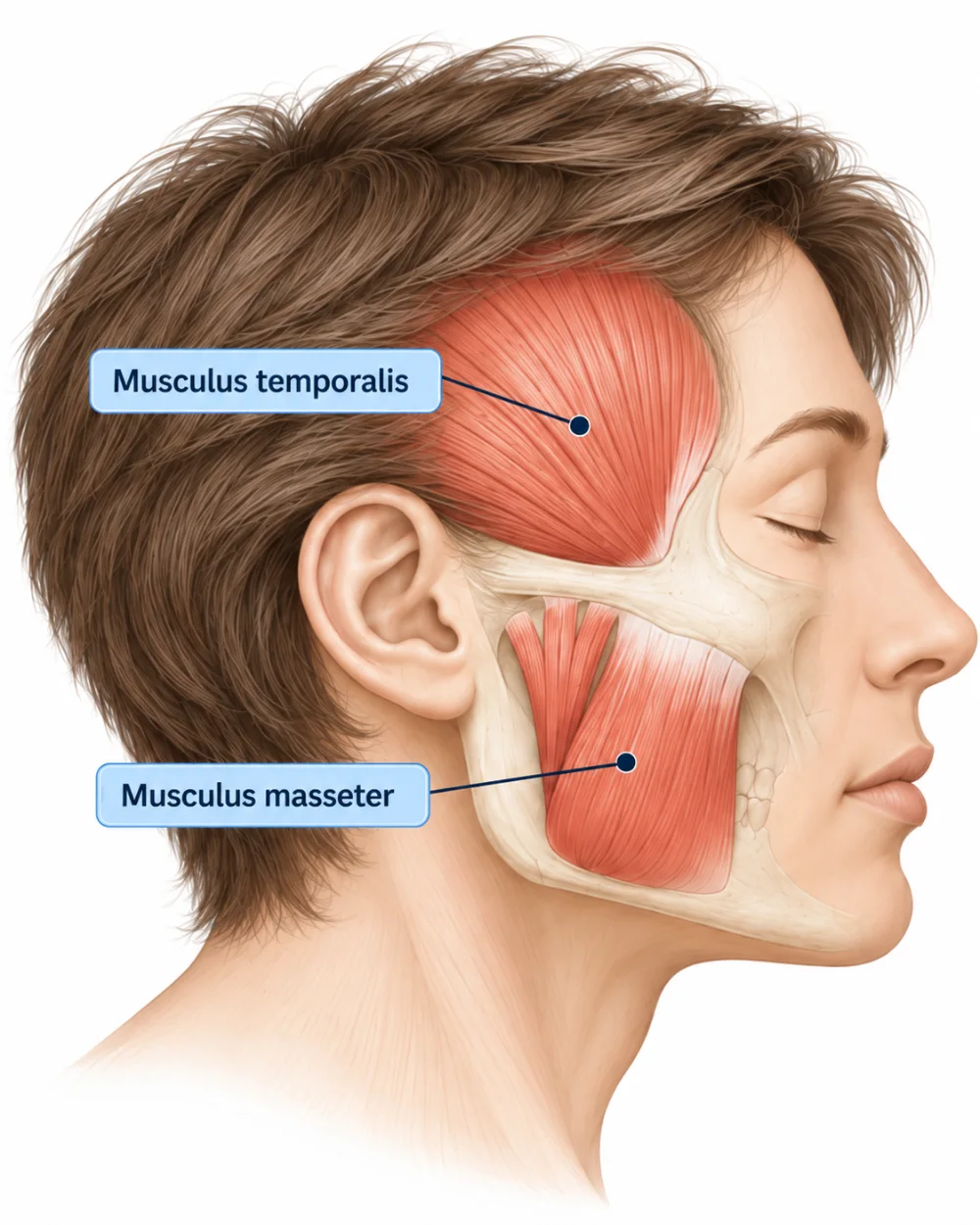
Temporalis (temple muscle) and masseter (main chewing muscle).
Injection treatment of the chewing muscles: relaxing the muscle itself
In pronounced bruxism, the main chewing muscle (masseter) and the temple muscle (temporalis) are permanently overactive. In the injection treatment, a small dose of a muscle-relaxing agent (botulinum toxin type A, a prescription medicine) is injected with a fine needle directly into the overactive muscle – usually the masseter, and the temporalis if needed. It temporarily blocks the transmission of nerve signals to the muscle fibres: the muscle works with less force, clenching and grinding decrease, and tension and pain subside. With appropriate dosing, chewing, speech and facial expression are preserved.
The effect begins after a few days, is fully developed after about two weeks and usually lasts three to six months. The body then breaks down the agent completely; the treatment can be repeated if needed.
Good to know: The use for bruxism is not part of the medicine’s official marketing authorisation in Switzerland (so-called off-label use). It is based on the scientific literature and is carried out after detailed informed consent. The current S3 guideline on bruxism lists the injection into the chewing muscles in adults as a treatment option that can be considered – particularly when splint therapy and conservative measures are not sufficient.
Bite splint and injection compared
| Bite splint | Injection treatment | |
|---|---|---|
| How it works | Protects the teeth, distributes the forces, relieves joints and muscles | Reduces the force of the overactive chewing muscles |
| Suitable for | Any form of grinding and clenching, TMD; basic treatment | Persistent muscle pain, tension or tension headaches despite the splint; markedly enlarged chewing muscles |
| Onset | Protection from the first night | After a few days, full effect after about two weeks |
| Duration | Several years, depending on wear | About three to six months per treatment |
| Effort | Impression, fitting, nightly wear | One session of around 20 minutes, repeated as needed |
| Possible side effects | Initial foreign-body sensation, increased salivation | Temporary pressure sensation, small bruises, weakness when chewing; rarely an uneven smile |
| Authorisation | Established standard dental procedure | Off-label use (application outside the official authorisation) |
| Costs | CHF 700-1,400 including fitting; contribution from basic insurance possible but not guaranteed | CHF 630 for the first session, CHF 540 for follow-up sessions; paid by the patient |
The two treatments do not exclude each other; they complement each other: the splint protects the teeth, the injection takes the force out of the muscles. For most patients who receive an injection, the splint therefore remains part of the treatment.
Which treatment when?
- Splint first. With tooth wear, sensitive teeth, clicking or grating sounds in the jaw joint and morning tension, the bite splint is the basic treatment. It protects the teeth – the injection does not.
- Injection in addition. If muscle pain, tension headaches or pronounced clenching persist despite a well-adjusted splint, physiotherapy and relaxation measures – or if the chewing muscles have become markedly enlarged from constant clenching.
- Injection alone. In individual cases, for example if a splint is not tolerated. Even then, protecting the teeth remains a topic to be discussed in the consultation.
Which treatment makes sense for you follows from the dental examination: teeth, jaw joints and chewing muscles are assessed; sleep, stress and symptoms are discussed. Because sleep bruxism is one of the sleep-related movement disorders and often occurs together with snoring and obstructive sleep apnea, at InterSleep the question of breathing during sleep is part of it – the online test gives a first assessment.
How the injection treatment works at the Swiss Dental Center
- Examination and consultation. Assessment of teeth, jaw joints and chewing muscles, clarification of possible contraindications, discussion of benefits, limits and costs. You receive written information and a cost estimate.
- Treatment. The injection areas are located by palpating the tensed muscle and marked. The agent is injected with a very fine needle at several points per muscle – usually three points in the masseter, plus the temporalis if needed. The session takes about 20 minutes; anaesthesia is usually not necessary.
- Afterwards. You can eat, speak and work again immediately. On the day of treatment you should not massage the injection sites and should avoid sport, sauna and alcohol.
- Follow-up. After two to four weeks the effect is checked and adjusted if necessary. A repeat treatment makes sense no earlier than three months later.
Effect, side effects and limits
What the evidence shows
Controlled studies and systematic reviews show that injections into the chewing muscles can reduce pain and the frequency of grinding episodes in bruxism. However, the studies differ in dosage, injection technique and follow-up period, and not all of them find a clear advantage over placebo or splint therapy. The injection is therefore an option with a documented effect, but not a promise – and it does not replace the splint.
Possible side effects
Most common are a temporary feeling of pressure or tightness, small bruises at the injection sites and weakness when chewing tough food in the first weeks. Rarely, the agent spreads to neighbouring muscles; the smile may then look uneven for a few weeks. All of these effects resolve because the agent is broken down completely. With frequent repetition over years, the literature discusses a decrease in muscle mass and changes in bone density at the angle of the jaw; the human data are inconsistent. Dosing is therefore conservative, and an interval of at least three months between treatments is observed.
When the treatment is not an option
The injection treatment is not suitable during pregnancy and breastfeeding, in disorders of neuromuscular transmission (for example myasthenia gravis), with infections in the treatment area, with known hypersensitivity to the agent, and when taking certain medicines such as aminoglycoside antibiotics or muscle relaxants. This is clarified in the consultation.
What the injection does not do
The injection dampens muscle activity but does not treat its causes – stress, sleep disorders, sleep apnea or certain medicines. It does not protect the teeth from wear and changes neither the bite nor the position of the jaw joint. Those remain the job of the bite splint.
Costs of the injection treatment
The injection treatment of the chewing muscles costs CHF 630 for the first session and CHF 540 for each follow-up session (top-up after a few months) at the Swiss Dental Center. Because it is an application outside the official authorisation, mandatory basic health insurance does not cover the costs; it is paid by the patient. Some supplementary insurance plans may contribute – check with your insurer before treatment. You receive a written cost estimate in advance. The costs of the bite splint (CHF 700-1,400) and the insurance rules can be found on the page Costs & health insurance.
Frequently asked questions about treating teeth grinding
Does the injection work better than the bite splint?
The two treatments have different jobs. The splint protects the teeth and relieves the jaw joints but changes muscle activity only indirectly. The injection reduces the force of the chewing muscles but does not protect the teeth. For persistent muscle symptoms, the combination is usually most effective.
How quickly does the injection treatment work, and how long does it last?
The effect begins after about three to seven days and is fully developed after around two weeks. It usually lasts three to six months. The muscle strength then returns; the treatment can be repeated.
Is the injection painful?
Most patients describe the injections with the very fine needle as easily tolerable, comparable to a vaccination. Anaesthesia is usually not necessary. A slight feeling of pressure can last a few days.
Will the treatment change my face?
Facial expression remains unchanged because only the chewing muscles are treated, not the muscles of facial expression. With markedly enlarged chewing muscles, the angle of the jaw may look slightly narrower after repeated treatments – a side effect, not a goal of the dental treatment.
What does off-label use mean for this treatment?
The medicine is officially authorised for other applications; its use for bruxism is not part of that authorisation. It is permitted when it is medically justified and you consent after detailed information. Because it is an application outside the authorisation, basic health insurance does not pay.
Does health insurance cover the injection treatment?
No, mandatory basic health insurance does not cover the injection treatment for bruxism. It costs CHF 630 for the first session and CHF 540 for each follow-up session and is paid by you. Whether your supplementary insurance contributes is best clarified with your insurer in advance.
Grinding, jaw pain or tension despite a splint? Book an examination appointment at the Swiss Dental Center: book online, phone 043 444 74 00 or via the contact form.
Author: Michael Adler, DMD, MSc – dentist specialising in dental sleep medicine · Last updated: September 2026 · Basis of this page: S3 guideline “Diagnosis and treatment of bruxism” (DGFDT/DGZMK) and current systematic reviews.